
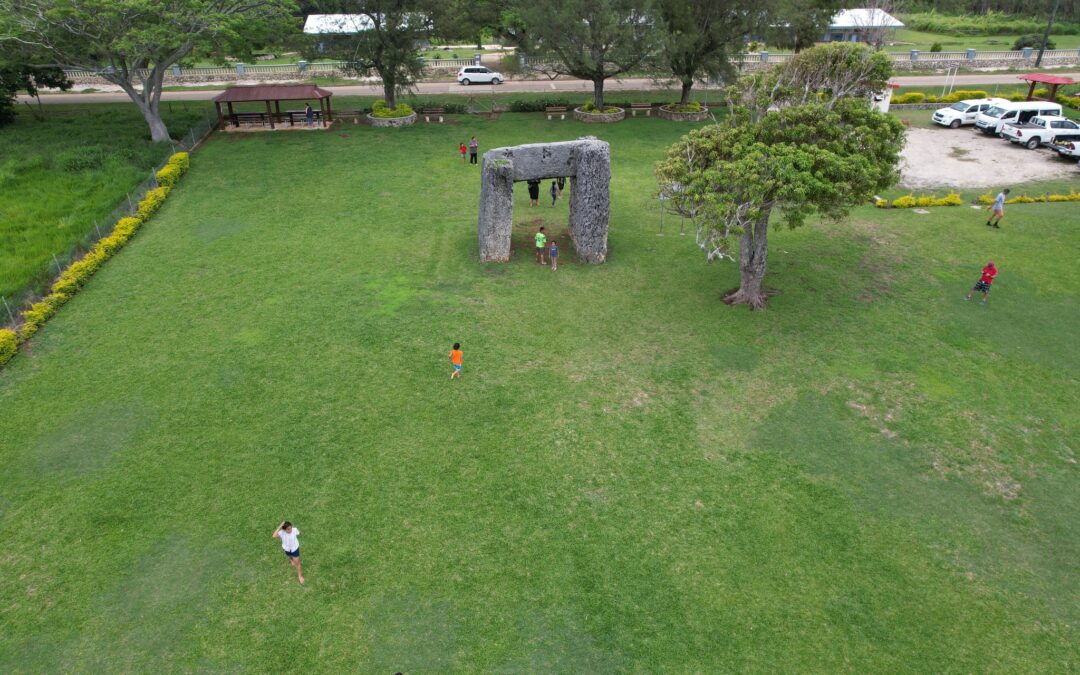
Location: Village of Niutoua, eastern Tongatapu — approximately 30km from Nuku'alofa. Free entry, donation box on site. Small parking area and souvenir stalls at the entrance.
Ha'amonga 'a Maui — meaning "The Burden of Maui" — is Tonga's most extraordinary ancient monument and one of the most significant megalithic structures in the entire Pacific. Known as the Stonehenge of the Pacific, this towering coral limestone trilithon has stood on the eastern tip of Tongatapu for over 800 years and remains one of the great engineering mysteries of Polynesia.
Built around 1200 AD by Tu'itatui, the 11th Tu'i Tonga king, the structure consists of three massive coral limestone slabs — two upright columns each standing 5.2 metres high and weighing between 30 and 40 tonnes, topped by a horizontal lintel 5.8 metres long. Deep mortise joints were cut into the top of each upright to lock the lintel in place — the same technique used at Stonehenge. How ancient Tongans quarried, transported, and lifted these stones without wheels, draft animals, or modern machinery remains a subject of fascination and debate.
The name reflects a dual meaning — it symbolises the yoke carried across the shoulders of a man bearing loads at both ends, and it represents the bond between Tu'itatui's two sons, Lafa and Talaiha'apepe, whose brotherhood the lintel stone symbolises by connecting the two uprights.
Approximately 100 metres from the trilithon stands the 'Esi Maka Faakinanga — the King's stone throne. Tu'itatui would rest his back against this slab while overseeing construction and receiving visitors, protected from assassination attempts from behind. The stone bears clear indentations shaped like a head, shoulders, and back.
In 1967, the late King Taufa'ahau Tupou IV proposed that the trilithon also functions as an ancient solar calendar. Notches carved into the top of the lintel align precisely with the sunrise at the summer solstice, winter solstice, and equinox — suggesting the structure may have guided planting seasons, navigation, and ceremonial timing. The site was submitted to UNESCO World Heritage Tentative Listing in 2007.
Tips: Best visited in the early morning when light is low and the site is quiet. Walk past the trilithon toward the langi (royal tombs) of Heketa. Sunrise at solstice through the archway is extraordinary if you can time your visit.